posted by: Asad
Smartphones vs DSLR Cameras
iPhone & Samsung vs Nikon & Sony — Which Camera Is Right for You in 2026?
Introduction
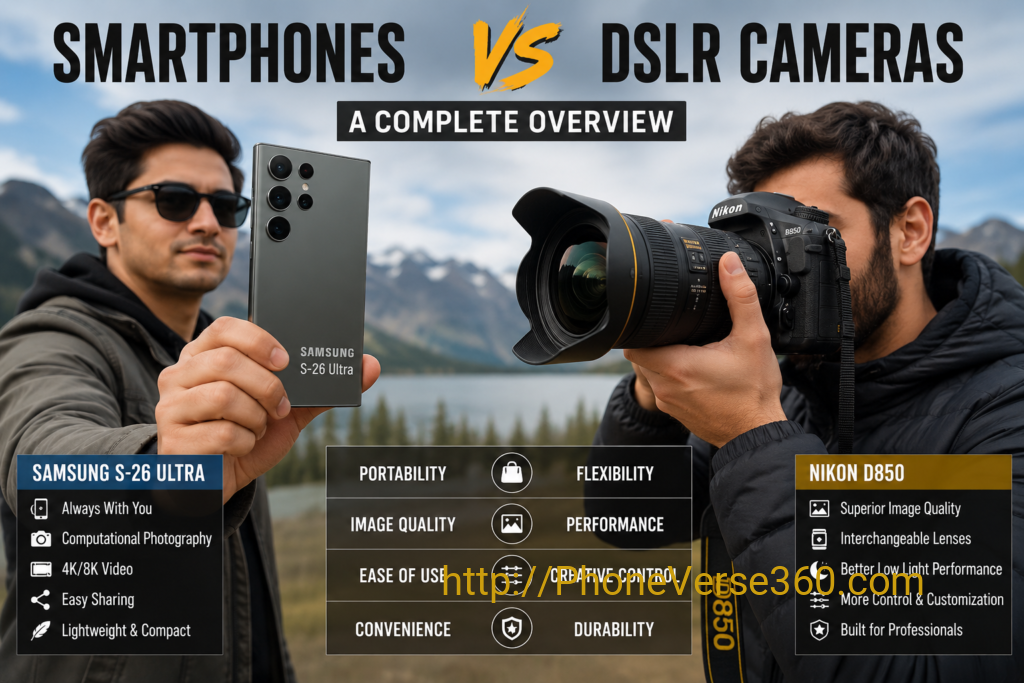
Photography has undergone a dramatic transformation over the past decade. What once required a bag full of expensive equipment and years of technical training can now be accomplished with a single device that fits in your pocket. Smartphones, led by the likes of Apple iPhone and Samsung Galaxy, have revolutionized how billions of people capture and share moments every single day. Yet, dedicated DSLR and mirrorless cameras from brands like Nikon and Sony continue to dominate professional photography, studio work, and serious enthusiast shooting.
So which is better — a smartphone or a DSLR camera? The answer is not straightforward. It depends entirely on your needs, your budget, your skill level, and how you plan to use your images. This article provides a detailed, honest comparison of smartphones and DSLR cameras, using real-world examples from the iPhone 17 Pro, Samsung Galaxy S26 Ultra, Nikon Z8, and Sony A7R V, to help you make the right decision.
The Rise of Smartphone Photography
Not long ago, the idea of using a phone to replace a camera was laughable. Early smartphone cameras produced grainy, washed-out photos with poor dynamic range and zero control over settings. Fast forward to 2026, and the story is completely different. The iPhone 17 Pro features a 48MP main sensor, a 5x optical zoom periscope lens, and Apple’s advanced photonic engine processing. Samsung’s Galaxy S26 Ultra pushes even further, with a 200MP primary camera, a 10x optical zoom, and an AI-powered scene optimizer that adjusts every shot in real time.
These are not gimmick features. The computational photography capabilities built into modern smartphones allow them to produce images that genuinely rival entry-level and even mid-range DSLR cameras in many real-world situations. Night Mode, Portrait Mode, and AI enhancement have all contributed to closing the gap between smartphone and dedicated camera photography significantly.
DSLR and Mirrorless Cameras: The Gold Standard
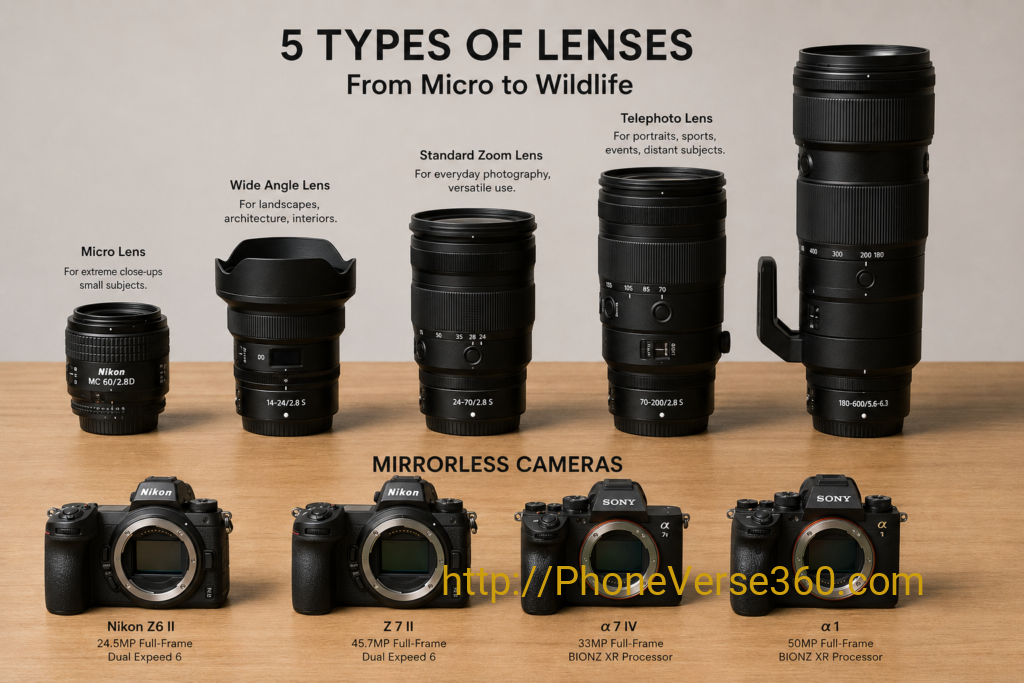
While smartphones have improved dramatically, DSLR and mirrorless cameras from Nikon and Sony remain the gold standard in image quality. The Nikon Z8 is a full-frame mirrorless powerhouse offering 45.7 megapixels, 8K RAW video recording, and an advanced autofocus system with subject detection for humans, animals, and vehicles. The Sony A7R V takes resolution even further with its 61MP back-illuminated sensor, offering extraordinary detail and dynamic range that no smartphone can match today.
The fundamental advantage of a DSLR or mirrorless camera lies in its sensor size and optics. Larger sensors capture more light, which directly translates into better performance in low light, richer color accuracy, shallower depth of field, and superior dynamic range. Interchangeable lenses allow photographers to use prime lenses, telephoto zooms, and specialty glass that produce optical results impossible to replicate through software processing alone.
Smartphones: Pros and Cons
Examples: Apple iPhone 17 Pro & Samsung Galaxy S26 Ultra
Pros of Smartphone Cameras
- Convenience and Portability: The biggest advantage of a smartphone is that it is always with you. The iPhone 17 Pro and Samsung Galaxy S26 Ultra fit in your pocket, making them the ultimate always-ready cameras. You never miss a moment because you forgot your camera bag at home.
- Computational Photography: Apple’s Photonic Engine and Samsung’s AI scene optimizer use machine learning to process multiple exposures instantly. Features like Night Mode, Smart HDR, and portrait bokeh deliver impressive results with zero effort from the user.
- Instant Sharing and Connectivity: Smartphones allow you to shoot, edit, and share photos to Instagram, WhatsApp, or your website in seconds. This real-time workflow is invaluable for content creators, journalists, and social media marketers.
- Affordable All-in-One Device: Your smartphone is your phone, camera, editor, and publishing tool in one device. The Samsung Galaxy S26 Ultra at around $1,299 is expensive as a phone but remarkably affordable as a complete photography and content creation system.
- Continuous Software Improvement: Unlike DSLR cameras, smartphone cameras improve through software updates. Apple and Samsung regularly release updates that add new shooting modes, improve processing algorithms, and enhance video capabilities without requiring new hardware.
Cons of Smartphone Cameras
- Small Sensor Size Limits Image Quality: Despite impressive megapixel counts, smartphone sensors are physically tiny compared to full-frame DSLR sensors. This means smartphones struggle in very low light and cannot match the dynamic range or color depth of a camera like the Nikon Z8 or Sony A7R V.
- No Optical Zoom Flexibility: While the Samsung Galaxy S26 Ultra offers 10x optical zoom, it is still far behind the flexibility of interchangeable DSLR lenses. A 600mm telephoto lens on a Sony A7R V for wildlife photography simply cannot be replicated on any smartphone.
- Battery Life Under Heavy Use: Using your smartphone as a primary camera drains the battery quickly. A full day of shooting with 4K video recording can leave you with a dead phone by midday, whereas dedicated cameras use separate batteries designed for long shooting sessions.
- Limited Manual Control: Although apps like ProCamera and Samsung’s Pro Mode offer manual controls, the experience of adjusting aperture, shutter speed, and ISO on a smartphone screen is not as intuitive or precise as using physical dials and buttons on a Nikon or Sony camera body.
- Overprocessed Images: Computational photography sometimes over-sharpens, over-saturates, or creates artificial-looking images. Professional photographers often prefer the more natural, film-like rendering of RAW files from a dedicated DSLR camera that can be carefully edited in post-production.
DSLR and Mirrorless Cameras: Pros and Cons
Examples: Nikon Z8 & Sony A7R V
Pros of DSLR and Mirrorless Cameras
- Superior Image Quality: The Sony A7R V’s 61MP full-frame sensor and the Nikon Z8’s 45.7MP sensor capture an extraordinary level of detail, color accuracy, and dynamic range that no smartphone sensor can match. For commercial, wedding, or landscape photography, the image quality difference is immediately visible.
- Interchangeable Lenses: The ability to swap lenses is one of the most powerful features of a DSLR or mirrorless system. From ultra-wide angle lenses for architecture, to macro lenses for product photography, to 600mm super telephoto lenses for wildlife — the creative possibilities are virtually unlimited.
- Exceptional Low-Light Performance: Large sensors with wide maximum apertures (such as f/1.4 or f/1.8 prime lenses) allow DSLR and mirrorless cameras to capture stunning images in extremely dark environments. The Nikon Z8 performs remarkably well at ISO 12,800 and beyond, producing clean, usable images where smartphones generate noise.
- Full Creative and Manual Control: Professional cameras give photographers complete control over every aspect of the exposure. Physical dials for aperture, shutter speed, ISO, and exposure compensation allow for precise, repeatable results. This level of control is essential for studio photography, sports, and creative artistic work.
- Professional Video Capabilities: The Nikon Z8 shoots 8K RAW video internally, and the Sony A7R V offers Cinema Line features with 4K oversampled footage. For professional filmmakers and video content creators who demand the highest quality, dedicated cameras offer capabilities that smartphones cannot yet match.
Cons of DSLR and Mirrorless Cameras
- High Cost: The Nikon Z8 body alone costs around $3,999, and the Sony A7R V retails for approximately $3,499. Add a selection of quality lenses, memory cards, batteries, and a camera bag, and you are looking at an investment of $6,000 to $15,000 or more. This is a significant barrier for casual photographers.
- Heavy and Bulky: A full-frame mirrorless camera with a professional lens attached is heavy and cumbersome to carry all day. For travel photography, street photography, or casual everyday shooting, carrying a DSLR setup quickly becomes a physical burden that discourages photographers from shooting.
- Steep Learning Curve: Mastering a professional camera system takes considerable time and dedication. Understanding the exposure triangle, metering modes, autofocus systems, RAW processing, and lens characteristics requires months or years of practice. Beginners can find the experience overwhelming compared to the point-and-shoot simplicity of a smartphone.
- Slow Sharing Workflow: Unlike a smartphone where photos can be shared instantly, DSLR images typically need to be transferred to a computer, edited in Adobe Lightroom or Photoshop, exported, and then uploaded. This workflow can take hours, making dedicated cameras poorly suited for social media content creation that demands speed.
- No Built-in Connectivity: Most DSLR cameras lack built-in cellular connectivity. While the Nikon Z8 and Sony A7R V offer Wi-Fi and Bluetooth for wireless transfer, the process of moving images to a phone or computer for sharing is significantly slower and more cumbersome than simply tapping a share button on a smartphone.
Head-to-Head Comparison: iPhone & Samsung vs Nikon & Sony
Camera Quality: Nikon Z8 and Sony A7R V Win
When it comes to pure image quality, the Nikon Z8 and Sony A7R V are in a different league. The 61MP sensor in the Sony A7R V captures images with a level of resolution and color fidelity that allows massive prints and extreme cropping. However, for everyday social media use and web publishing, the iPhone 17 Pro and Samsung Galaxy S26 Ultra produce excellent images that are indistinguishable from a DSLR to most viewers.
Video: Smartphones Lead in Convenience, DSLRs in Quality
The iPhone 17 Pro shoots stunning 4K ProRes video and even supports Log recording for professional color grading. Samsung Galaxy S26 Ultra also offers excellent 8K video recording. However, for cinematic productions and broadcast-quality content, the Nikon Z8’s 8K RAW internal recording and Sony A7R V’s Cinema Line features remain the professional standard.
Low Light: DSLRs Still Have the Edge
In very dark conditions, the larger sensors of the Nikon Z8 and Sony A7R V produce significantly cleaner images than any smartphone. While Apple’s Night Mode and Samsung’s Nightography feature are impressive for smartphone photography, they rely heavily on computational tricks like multi-frame processing and AI noise reduction, rather than true optical superiority.
Portability and Everyday Use: Smartphones Win Easily
For travel, family events, street photography, and content creation on the go, the iPhone 17 Pro and Samsung Galaxy S26 Ultra are simply unbeatable. They are slim, lightweight, and always connected. No dedicated camera can compete with the convenience and immediacy of a smartphone in these scenarios.
Who Should Use Which Camera?
Choose a Smartphone If…
You are a content creator, blogger, travel photographer, or social media influencer who needs to shoot and share quickly. If your primary outlets are Instagram, YouTube, TikTok, or a website, the iPhone 17 Pro or Samsung Galaxy S26 Ultra will serve you extremely well and save you thousands of dollars compared to a professional camera setup.
Choose a DSLR or Mirrorless Camera If…
You are a professional photographer, commercial shooter, wedding photographer, wildlife photographer, or serious creative who demands the highest possible image quality. If you are printing large format images, shooting in challenging lighting conditions, or producing professional video content, the Nikon Z8 or Sony A7R V are worth every penny of the investment.
Conclusion
The debate between smartphones and DSLR cameras is no longer about one being objectively better than the other. It is about understanding your specific needs and choosing the right tool for the job. The iPhone 17 Pro and Samsung Galaxy S26 Ultra represent extraordinary achievements in mobile photography, offering capabilities that would have seemed impossible just five years ago. At the same time, the Nikon Z8 and Sony A7R V remain the undisputed champions of image quality, creative control, and professional performance.
For most people in 2026, a flagship smartphone is all the camera they will ever need. But for those who are serious about photography as a craft or a profession, a dedicated mirrorless camera system continues to offer a level of image quality, creative flexibility, and technical performance that no smartphone can yet replicate. The best approach? Use both — let your smartphone handle everyday moments and social media, and reach for your DSLR or mirrorless camera when the shot truly matters.
For INFO : Check SMARTPHONES WITH 200 MEGA PIXEL CAMERAS