
1. Leadership Explained
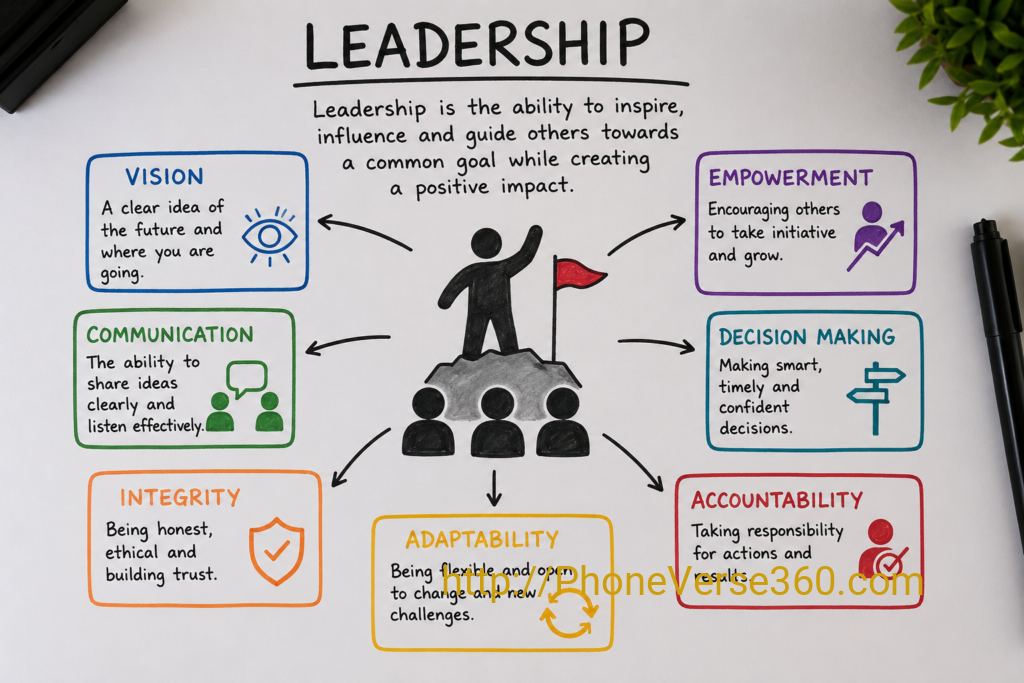
Leadership is the ability to guide, influence, and inspire people toward achieving a common goal. A leader is responsible for making decisions, solving problems, managing teams, and shaping the direction of an organization, company, or even a nation. It is said, “A true leader does not create followers; a true leader inspires others to become leaders themselves.”
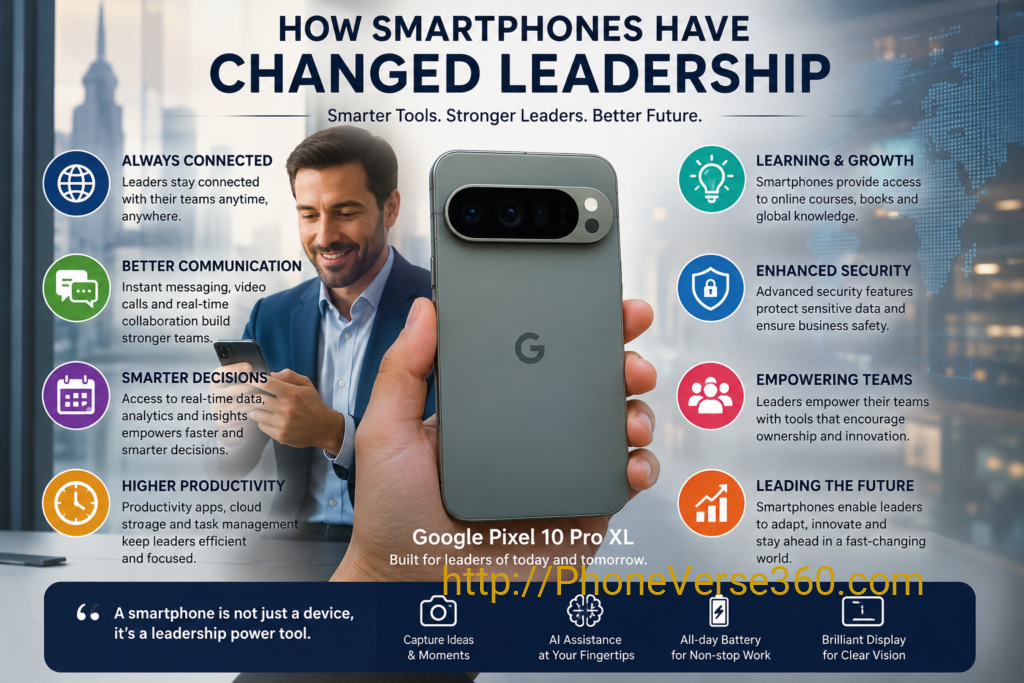
Before the entry of smart phones, leadership depended heavily on physical presence, paperwork, face-to-face meetings, and delayed communication. However, in today’s digital world, smartphones have completely changed how leadership works by making information and decision-making faster and more connected.
2. How Smartphones Changed Leadership (with Examples of Tech Leaders)
Smartphones have transformed leadership by giving leaders instant access to global information, communication tools, and real-time decision-making systems.
Example of Tech Leaders Using Smartphones Effectively
- Elon Musk (Tesla, SpaceX)
Known for making fast decisions and managing global companies, Musk uses mobile communication tools to stay updated with engineering teams and global operations in real time. - Tim Cook (Apple CEO)
Uses Apple’s ecosystem and mobile tools to monitor supply chains, product launches, and global operations efficiently. - Satya Nadella (Microsoft CEO)
Focuses on cloud and AI integration, often using mobile-based dashboards and communication systems to manage global teams.
These leaders represent a modern leadership style where smartphones act as a control center for business operations.
3. New Leaders vs Old Leaders (Without Smartphones)
Old Leadership Style
- Slow communication through letters, emails, or landline phones
- Physical presence required for most meetings
- Delayed decision-making
- Limited access to real-time data
- Dependence on assistants and paper reports
For example, business leaders in the past had to travel physically or send letters to communicate with international teams. Important decisions and approvals could take several days or weeks.
Modern Smartphone-Enabled Leadership
- Instant communication through WhatsApp, email, and apps
- Remote decision-making from anywhere in the world
- Real-time dashboards and analytics
- Virtual meetings and global collaboration
- Direct access to data and reports on mobile devices
For example, modern CEOs can approve projects, join Zoom meetings, and monitor company operations instantly through smartphones. They can communicate with global teams in real time from anywhere in the world.
Smartphones have removed distance barriers and made leadership more agile and responsive.
4. How Smartphones Help Leaders Make Quick and Right Decisions
Smartphones provide leaders with instant access to critical information, allowing faster and more accurate decisions.
Examples include:
- Real-time stock market updates for financial decisions
- Live sales data for business strategy adjustments
- Emergency alerts and crisis management updates
- Instant communication with team members worldwide
For example, a business leader can approve a million-dollar project, analyze risks, and communicate with teams—all from a smartphone within minutes. In the past, this process could take days or even weeks.
Taking one other example, an investment advisor, residing in Japan, want to put his money in New York Stock Exchange can take all the required information related to his investment from his smartphone in well-structured manners. Accordingly, he can make decision.
5. Automation and AI in Leadership
Artificial Intelligence and automation have become powerful tools for modern leaders using smartphones.
How AI Helps Leaders
- Predictive analytics for business forecasting
- Smart assistants for scheduling and reminders
- Automated report generation
- Customer behavior analysis
- Risk detection in financial systems
Automation Benefits
- Reduces manual workload
- Increases accuracy in decision-making
- Speeds up repetitive tasks
- Improves productivity and efficiency
AI-powered smartphones act like personal advisors, helping leaders make data-driven decisions instead of relying only on intuition.
6. Can AI Smartphones Replace Leaders?
The idea of AI replacing leaders is a complex topic.
Arguments for AI Replacing Some Leadership Functions
- AI can analyze data faster than humans
- AI can predict outcomes with high accuracy
- AI can remove emotional bias in decisions
- AI can automate routine management tasks
Arguments Against Full Replacement
- Leadership requires emotional intelligence
- Human judgment is needed in uncertain situations
- Ethics and values cannot be fully programmed
- Inspiration and motivation come from humans, not machines
Conclusion on This Question
AI smartphones can assist leaders but cannot fully replace them. The future is likely to be AI-supported leadership, not AI-controlled leadership.
7. Way Forward and Challenges
Way Forward
- Integration of AI decision-support systems in smartphones
This will help leaders analyze data quickly and make smarter business decisions in real time. - Real-time global leadership dashboards
Leaders will be able to monitor company performance, teams, and operations from anywhere instantly. - Smarter communication tools for remote teams
Advanced mobile communication apps will improve collaboration and productivity among global teams. - Advanced cybersecurity for leadership data
Stronger security systems will protect sensitive business and leadership information from cyber threats. - AI assistants tailored for executives
AI-powered assistants will help executives manage schedules, tasks, meetings, and strategic planning more efficiently.
Challenges
· Data privacy and security risks
Sensitive leadership and company data can be exposed if smartphones or apps are not properly secured.
· Over-dependence on technology
Leaders may rely too much on smartphones and AI, reducing independent thinking and judgment.
· Risk of misinformation or AI errors
Wrong data or AI-generated insights can lead to poor or misleading decisions.
· Cyberattacks targeting leaders and organizations
Hackers may target smartphones to steal confidential business or financial information.
· Digital inequality in access to advanced tools
Not all leaders or regions have equal access to advanced smartphones and AI technologies, creating a gap in performance.
Conclusion
Smartphones have completely redefined modern leadership. From instant communication to AI-powered decision-making, leaders now operate in a faster, more connected, and data-driven world. For sure, AI will support leadership in vast areas of decision making.
While technology enhances leadership efficiency, true leadership still depends on human vision, emotional intelligence, and ethical responsibility. The future belongs to leaders who can effectively combine human judgment with smartphone-powered intelligence.
Further Study: Look how Smartphone have changed life of Professionals: Click Here